


In this section we define a natural approximation preserving reducibility and introduce the notion of completeness both in NPO and in A PX .
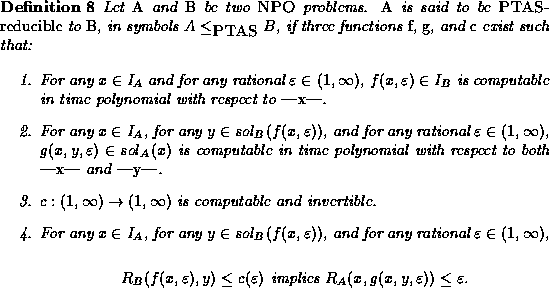


From Proposition
1
it immediately follows that if an NPO problem
A
is
NPO-complete (respectively, A
PX
-hard) then it does not belong to A
PX
(respectively, PTAS). It is also possible to prove that if
A
is
NPO-complete (respectively, NPO PB-complete) then it cannot be approximated
within
 (respectively,
 ) for some
 .
.
The syntactically defined classes M AX SNP (containing e.g. M AXIMUM 3-S ATISFIABILITY and M AXIMUM C UT ) and M AX NP (containing e.g. M AXIMUM S ATISFIABILITY ) were defined in [ 284 ]. Recently was shown that the closures of these classes under PTAS-reduction were identical to A PX \ [ 217 ] and [ 88 ]. In the compendium we therefore always use the term A PX -complete instead of M AX SNP - complete and A PX -hard instead of M AX SNP - hard .
The classes M AX PB and M IN PB consisting of the polynomially bounded maximization and minimization problems, respectively, were defined in [ 238 ]. The closures of these classes under PTAS-reduction have recently been shown to be identical to NPO PB [ 85 ]. In the compendium we therefore always use NPO PB-complete instead of M AX PB - complete and M IN PB - complete .
Viggo Kann

