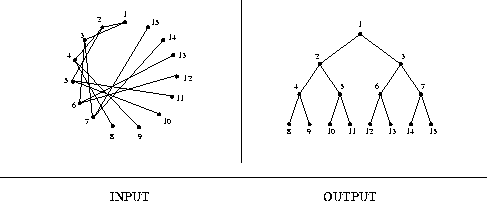

Input description: A tree T, which is a graph without any cycles.
Problem description: A nice drawing of the tree T.
Discussion: There are as many reasons to want to draw trees as there are types of structures that trees represent. Consider software and debugging tools that illustrate the hierarchical structure of file system directories, or that trace the execution of a program through its subroutines.
The primary issue in drawing trees is establishing whether you are drawing free or rooted trees:
Since trees are always planar graphs, they can and should be drawn such that
no two edges cross.
Any of the planar drawing algorithms of Section  could be used to do so.
However, such algorithms are overkill, because much simpler algorithms
can be used to construct planar drawings of trees.
The spring-embedding heuristics of Section
also work well on free trees,
although they may be too slow for many applications.
could be used to do so.
However, such algorithms are overkill, because much simpler algorithms
can be used to construct planar drawings of trees.
The spring-embedding heuristics of Section
also work well on free trees,
although they may be too slow for many applications.
The most natural tree-drawing algorithms work with rooted trees. However, they can be used equally well with free trees by selecting one vertex to serve as the root of the drawing. This faux-root can be selected arbitrarily, or, even better, by using a center vertex of the tree. A center vertex minimizes the maximum distance to other vertices. For trees, the center always consists of either one vertex or two adjacent vertices, so pick either one of them. Further, the center of a tree can be identified in linear time by repeatedly trimming all the leaves until only the center remains.
Your two primary options for drawing rooted trees are ranked and radial embeddings:
Such ranked embeddings are particularly effective for rooted trees used to represent a hierarchy, be it a family tree, a data structure, or a corporate ladder. The top-down distance illustrates how far each node is from the root. Unfortunately, such a repeated subdivision eventually produces very narrow strips, until most of the vertices are crammed into a small region of the page. You should adjust the width of each strip to reflect the total number of nodes it will contain, or even better, the maximum number of nodes on a single level.
Implementations: Georg Sander maintains a comprehensive WWW page on graph drawing at http://www.cs.uni-sb.de/RW/users/sander/html/gstools.html. This should probably be your first stop in hunting down programs for tree drawing.
The best FTP-able package of graph drawing algorithms is
GraphEd, by Michael Himsolt (himsolt@fmi.uni-passau.de).
It contains a variety of graph and tree drawing algorithms
and an interface to support user-specific extensions
written in C.
See Section for more details on GraphEd and
other graph drawing systems.
Combinatorica [Ski90] provides Mathematica implementations
of several tree drawing algorithms, including radial and rooted embeddings.
See Section for further information on Combinatorica.
Notes: The best reference available on graph drawing is
the annotated bibliography on graph drawing
algorithms by Giuseppe Di Battista, Peter Eades, and
Roberto Tamassia [BETT94], also
available via http://www.cs.brown.edu/  rt.
rt.
Heuristics for tree layout have been studied by several researchers [RT81, Vau80, WS79], although under certain aesthetic criteria the problem is NP-complete [SR83].
Related Problems: Drawing graphs (see page ),
planar drawings (see page ).