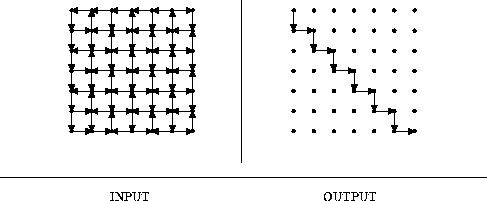

Input description: An edge-weighted graph G, with start vertex and end vertex t.
Problem description: Find the shortest path from to t in G.
Discussion: The problem of finding shortest paths in a graph has a surprising variety of applications:
 .
.
The primary algorithm for finding shortest paths is Dijkstra's algorithm,
which efficiently finds the shortest paths from a given vertex
x to all n-1 other vertices.
Dijkstra's algorithm starts from x.
In each iteration, it identifies a new
vertex v for which the shortest path from x to v is known.
We maintain a set of vertices S to which we currently know the shortest
path from v, and this set grows by one vertex in each iteration.
In each iteration, we identify the edge (u,v) where  and
and  such that

This edge (u,v) gets added to a shortest path tree, whose root is x
and which describes all the shortest paths from x.
See the discussion in Section for more details.
The straightforward implementation of this algorithm is O(m n).
However, with
simple data structures it can be reduced to  or
or  time.
Theoretically faster times can be achieved using significantly more complicated
data structures, as described below.
If we are just interested in knowing the shortest path from x to y, simply
stop as soon as y enters S.
time.
Theoretically faster times can be achieved using significantly more complicated
data structures, as described below.
If we are just interested in knowing the shortest path from x to y, simply
stop as soon as y enters S.
Dijkstra's algorithm is the right choice for single-source shortest path on positively weighted graphs. However, special circumstances dictate different choices:
Why might one ever need to find shortest paths in graphs with
negative cost edges?
An interesting application comes in currency speculation.
Construct a graph where each vertex is a nation and there is an edge weighted
 from x to y if the exchange rate from
currency x to currency y is w(x,y).
In arbitrage, we seek a cycle to convert currencies so that we
end up with more money than we started with.
For example, if the exchange rates are 12 pesos per dollar,
5 pesos per franc, and 2 francs per dollar, by simply
moving money around we can convert $1 to $1.20.
In fact, there will be a profit opportunity whenever there exists a
negative cost cycle in this weighted graph.
from x to y if the exchange rate from
currency x to currency y is w(x,y).
In arbitrage, we seek a cycle to convert currencies so that we
end up with more money than we started with.
For example, if the exchange rates are 12 pesos per dollar,
5 pesos per franc, and 2 francs per dollar, by simply
moving money around we can convert $1 to $1.20.
In fact, there will be a profit opportunity whenever there exists a
negative cost cycle in this weighted graph.
on motion planning. with
with  )
also suffices for finding the longest path in a DAG. which is useful
in many applications like scheduling (see Section ).
)
also suffices for finding the longest path in a DAG. which is useful
in many applications like scheduling (see Section ). dynamic programming
algorithm for all-pairs shortest path, which is faster and easier to
program than Dijkstra
and which works with negative cost edges (but not cycles).
It is discussed more thoroughly in Section .
Let M denote the distance matrix, where
dynamic programming
algorithm for all-pairs shortest path, which is faster and easier to
program than Dijkstra
and which works with negative cost edges (but not cycles).
It is discussed more thoroughly in Section .
Let M denote the distance matrix, where  if there is no
edge (i,j).
if there is no
edge (i,j).

for k = 1 to n do
for i = 1 to n do
for j = 1 to n do

Return

The key to understanding Floyd's algorithm is that  denotes
``the length of the
shortest path from i to j that goes through at most k intermediate
vertices.''
Note that space suffices, since we need keep only
denotes
``the length of the
shortest path from i to j that goes through at most k intermediate
vertices.''
Note that space suffices, since we need keep only  and
and  around at time k.
 for
for  , which is
the length of the shortest
way to get from vertex i to i,
in other words the shortest cycle through i.
, which is
the length of the shortest
way to get from vertex i to i,
in other words the shortest cycle through i.
This might be exactly what you want. However, the shortest cycle through x is likely to go from x to y back to x, using the same edge twice. A simple cycle is one that visits no edge or vertex twice. To find the shortest simple cycle, the easiest approach is to compute the lengths of the shortest paths from i to all other vertices, and then explicitly check whether there is an acceptable edge from each vertex back to i.
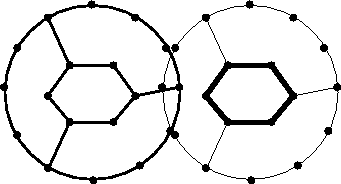
Figure: The girth, or shortest cycle, in a graph
Finding the longest cycle in a graph includes the special case of
Hamiltonian cycle (see ), so it is NP-complete.
The all-pairs shortest path matrix can be used to compute several useful invariants of any graph G, that are related to the center of G. The eccentricity of a vertex v in a graph is the shortest-path distance to the farthest vertex from v. From the eccentricity come other graph invariants. The radius of a graph is the smallest eccentricity of any vertex, while the center is the set of vertices whose eccentricity is the radius. The diameter of a graph is the maximum eccentricity of any vertex.
Implementations: The highest performance code (for both Dijkstra and Bellman-Ford) available for finding shortest paths in graphs is SPLIB [CGR93], developed in C language by Cherkassky, Goldberg, and Radzik. They report solving instances with over one million vertices in under two minutes on a Sun Sparc-10 workstation. Their codes are available from http://www.neci.nj.nec.com/homepages/avg.html for noncommercial use.
LEDA (see Section ) provides good implementations in C++
for all of the shortest-path algorithms we have discussed,
including Dijkstra, Bellman-Ford, and Floyd's algorithms.
Pascal implementations of Dijkstra, Bellman-Ford, and Floyd's algorithms
are given in [SDK83].
See Section .
XTango (see Section )
includes animations of both Dijkstra's and Floyd's shortest-path
algorithms.
Combinatorica [Ski90] provides Mathematica implementations
of Dijkstra's and Floyd's algorithms for shortest paths,
acyclicity testing, and girth computation for directed/undirected
and weighted/unweighted graphs.
See Section .
The Stanford GraphBase (see Section ) contains
an implementation of Dijkstra's algorithm, used for computing word
ladders in a graph defined by five-letter words,
as well as an implementation of a program to bound the girth of
graphs.
Algorithm 562 [Pap80] of the Collected Algorithms of the ACM is a Fortran program
to find shortest paths in graphs (see Section ).
Notes: Good expositions on Dijkstra's algorithm [Dij59] and Floyd's all-pairs-shortest-path algorithm [Flo62] include [Baa88, CLR90, Man89]. Good expositions of the Bellman-Ford algorithm [Bel58, FF62] are slightly rarer, but include [CLR90, Eve79a, Law76]. Expositions on finding the shortest path in a DAG include [Law76].
A survey on shortest-path algorithms with 222 references appears in [DP84]. Included are citations to algorithms for related path problems, like finding the kth-shortest path and shortest paths when edge costs vary with time. Expositions on finding the kth-shortest path include [Law76].
The theoretically fastest algorithms known for single-source shortest path for positive edge weight graphs are variations of Dijkstra's algorithm with Fibonacci heaps [FT87]. Experimental studies of shortest-path algorithms include [DF79, DGKK79]. However, these experiments were done before Fibonacci heaps were developed. See [CGR93] for a more recent study.
Theoretically faster algorithms exist when the weights of the edges are small;
i.e. their absolute values are each bounded by W.
For positive edge weights, the single-source-shortest-path can be found
in  [AMOT88], while
  suffices for graphs with negative edge weights [GT89]
Related Problems: Network flow (see page ),
motion planning (see page ).